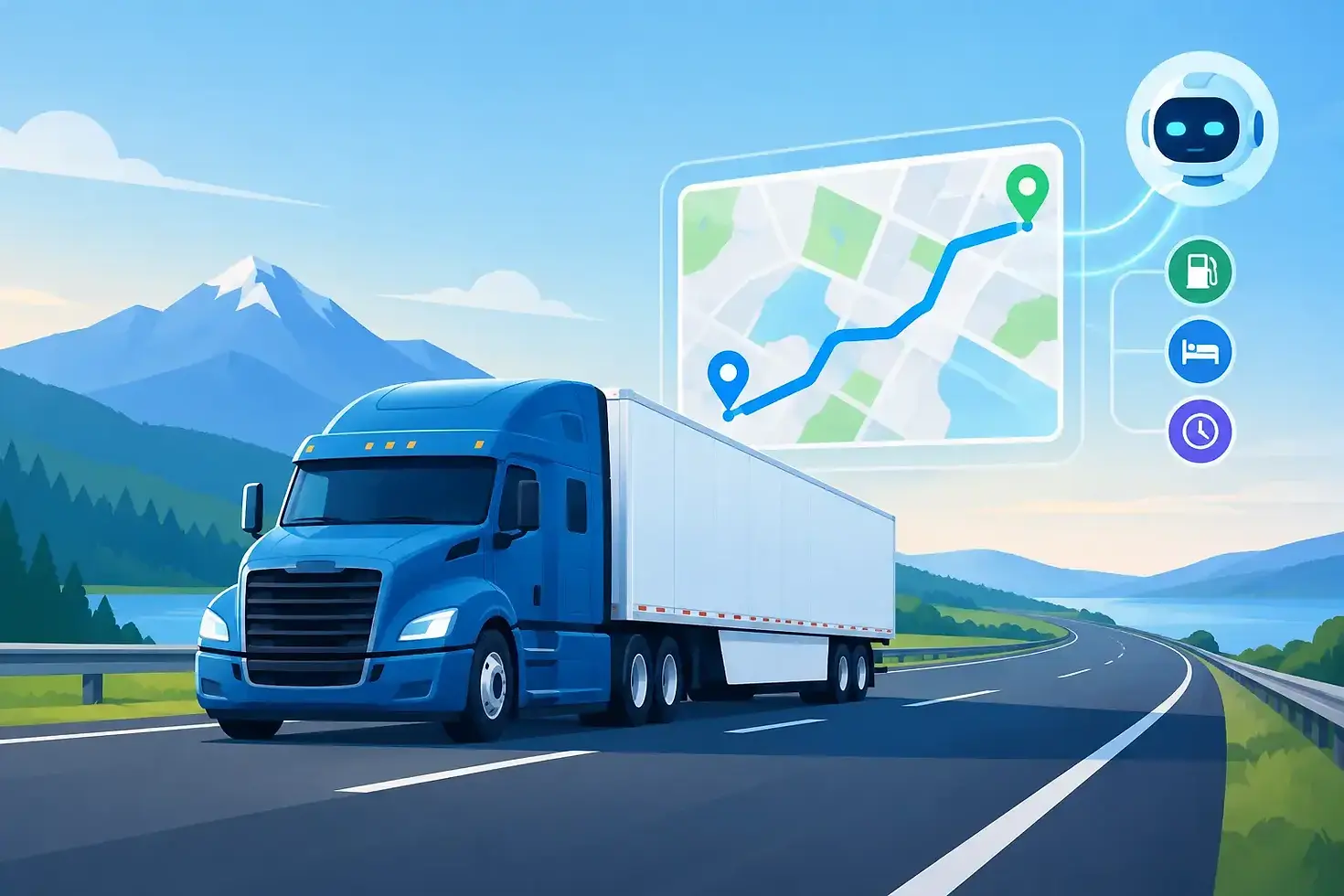
AI Route Planning for Truckers That Pays
A route that looks good on a map can still put your truck in a bad position. Maybe the rate gets you moving, but the reload market is thin. Maybe the miles are clean, but appointment times burn half a day. Maybe the route runs through a toll-heavy corridor, a mountain pass, or a market where fuel and parking take a bigger bite than expected. That is where AI route planning can be useful - not as a replacement for trucking judgment, but as another tool for protecting your time, fuel, and revenue.
For owner-operators and small fleets, the real question is not whether a routing tool can find the fastest path. Most navigation apps can do that. The question is whether the route supports a profitable next move for the truck.
What AI Route Planning Actually Means in Trucking
AI route planning uses software to process more variables than a basic map can handle. Depending on the tool and data available, it can consider mileage, traffic patterns, weather, fuel stops, tolls, hours-of-service limits, appointment windows, road restrictions, and historic travel times. In a dispatch setting, it can also help compare load options based on where a truck will land and what freight may be available afterward.
That last part matters. A $2.50-per-mile load is not automatically a good load if it delivers into a weak freight market and leaves you running 150 empty miles for the next pickup. On the other hand, a slightly lower rate can make sense when it positions you in a strong lane, gets you home when you need to be there, or keeps you close to a regular customer.
The value of AI is speed. It can sort through route combinations and operating factors faster than one person can do by hand. But it only works as well as the information fed into it. A tool does not know your preferred fuel network, your trailer's real operating limitations, or whether you refuse to run certain cities unless those details are part of the decision.
Where AI Route Planning Helps a Working Truck
The best use of AI route planning is not chasing a perfect route. There is no perfect route once traffic, weather, receiver delays, construction, and last-minute broker changes enter the picture. Its job is to give the carrier a clearer starting point and make trade-offs visible before accepting the load.
A good system can help a dispatcher compare whether a load should be run through a toll road or around it, whether a fuel stop should happen before or after a state line, and whether the pickup can be made legally without pushing hours too tight. It can flag routes that look short but carry extra time risk because of congestion, difficult terrain, or limited truck parking.
It can also help reduce deadhead by looking beyond the current load. Instead of treating each booking as a separate transaction, the route can be planned as a chain: where the truck is now, where it needs to be, what it can legally cover, and where the next paying opportunity is likely to appear. That is how dispatch becomes more than simply finding a load on a board.
For a reefer, that may mean weighing a higher-rate produce load against detention risk and a long wait at the receiver. For flatbed or step deck work, it may mean accounting for securement time, permitted routing, or roads that are not friendly to the equipment. A box truck running regional freight has different limits than a 53-foot dry van running coast to coast. The software should support the operation, not force every truck into the same plan.
The inputs still have to be honest
AI can calculate quickly, but it cannot fix bad assumptions. If the planned transit time assumes every fuel stop takes 15 minutes, ignores a required break, or treats all miles as equal, the result will look better on paper than it performs on the road.
For route planning to be useful, the operating picture needs to include at least four real-world factors:
The truck's equipment, weight, and practical routing limits
Available hours, appointment times, and expected loading or unloading delays
Fuel cost, toll exposure, parking needs, and likely traffic conditions
The strength of freight options at delivery and along the next lane
Those details turn a route from a line on a screen into an operating plan. They also explain why an experienced dispatcher may reject a load that looks attractive at first glance.
A Better Route Is Not Always the Shortest Route
Shortest miles can save fuel, but mileage alone is not the whole calculation. A route that avoids tolls may add enough time to cause an overnight delay or put a driver into a poor parking situation. A faster route may cost more in tolls but protect an appointment, preserve hours, and position the truck for a strong reload.
The right choice depends on the truck's cost structure and the carrier's goals. If home time matters this week, a route that moves you toward the house may carry more value than a few extra cents per mile. If you are building a consistent lane, it may be worth taking a lower-paying backhaul that keeps the truck moving and helps establish dependable freight relationships.
This is where a carrier-first dispatch approach earns its keep. The load board provides options. Routing technology provides data. Neither one knows your business as well as you do. The real work is matching the numbers to your priorities.
AI Cannot Negotiate a Bad Load Into a Good One
There is plenty of excitement around AI, and some of it is deserved. Still, no routing tool can make up for weak rate confirmation terms, poor communication from a broker, unrealistic appointment windows, or a receiver known for holding drivers for hours.
It also cannot see every condition that affects a truck. Road closures update late. Weather shifts. A shipper changes a pickup number. A parking lot fills before sunset. Experienced drivers and dispatchers account for those realities because they have lived them.
That is why AI should be treated as decision support, not automatic dispatch. If a system says a load works but the plan leaves no margin for a breakdown, a delayed shipper, or a required reset, the plan is too tight. Good operations leave room for the road to be the road.
The same caution applies to load recommendations. Software may identify a strong posted rate, but an experienced dispatcher still needs to check the broker, confirm the commodity, look at the pickup and delivery requirements, and make sure the lane fits the carrier. A high gross number does not mean much if the load creates unpaid work, expensive deadhead, or a bad next-day position.
How Carriers Can Put the Technology to Work
Start with your own standards. Know your minimum rate, acceptable deadhead, preferred regions, home-time needs, and equipment requirements before asking a system to recommend freight. Without those guardrails, AI will optimize for whatever metric it was given, and that may be raw miles instead of net revenue.
Then look at routes in sequence, not one load at a time. Before accepting a run, ask what happens at delivery. Is there outbound freight? Will you be near a preferred lane? Is the delivery day and time likely to create a long layover? Does the route leave enough hours to pursue the next move without scrambling?
It also pays to compare planned performance against actual performance. If a route regularly takes longer than estimated, costs more in fuel, or produces more downtime than expected, adjust the assumptions. The best routing process gets smarter because the carrier pays attention to what the truck really does, not what a spreadsheet hoped it would do.
At Seaglass Logistics, that practical side matters. A route plan has to work for the truck, the driver, and the business behind it. Technology can speed up the search and sharpen the choices, but personal knowledge of your lanes, equipment, and goals is what keeps the plan grounded.
Use the Data, Keep the Judgment
AI route planning is worth using when it helps you spot costly deadhead, protect available hours, compare route trade-offs, and position the truck for better freight. It is not worth following blindly when it ignores the realities of a particular load or the way you choose to run your business.
The strongest route is usually not the one an app labels fastest. It is the one that puts more of your miles, hours, and fuel to work for you - and leaves you in a better place when the next load needs to be booked.

Comments